





AI AGENT DEVELOPMENT COMPANY

Deploy Production Ready AI Agents

Your processes still depend on people, where autonomous intelligence should be doing the work 24/7. We, as your trusted AI agent development partner, close that gap and build production-ready agents to replace costly human-dependent workflows with intelligent AI agents that execute, scale, and compound value over time.

AI Agent Development

Trusted Across Leading Enterprises

What is AI Agent Development?

Typical enterprise software is usually programmed to wait to be instructed on what to do, unlike AI agents. They are autonomous.

AI agent development is the process of designing, building, and deploying autonomous software systems called AI agents that perceive their environment, reason via goals, and execute multi-step tasks without continuous human input. 

Unlike basic automation or chatbots, AI agents are built on large language models (LLMs) like GPT-4, Claude, or Gemini, layered with memory systems, tool-calling capabilities, planning modules, and orchestration frameworkssuch as LangGraph, CrewAI, or AutoGen.

A production-grade AI agent by DataToBiz can:

  • Perceive inputs across data sources, APIs, documents, and live systems
  • Reason using chain-of-thought, ReAct, or multi-step planning loops
  • Execute actions like writing code, querying databases, sending outputs, and triggering workflows
  • Learn and adapt via memory layers and feedback loops over time

Which Industries Use AI Agents?

Inefficiency is not industry-specific; neither is the fix. AI agents are reshaping operations across sectors and compounding ROI wherever repetitive, high-stakes, or data-heavy work exists.

Healthcare & Life Sciences

Clinical teams lose hours to administrative work that slows care and delays decisions. AI agents handle the repetitive layer, keeping focus on patients and outcomes.

  • EHR data capture, processing, and appointment scheduling
  • AI voice agents for patient intake, triage, and remote consultations
  • Clinical research automation and medical imaging analysis
  • Compliance monitoring across workflows

Financial Services & Banking

Fraud evolves faster than manual checks. Compliance lags. Decisions take longer than they should. AI agents bring speed and accuracy to core financial workflows.

  • Anti-money laundering monitoring and fraud detection
  • Loan underwriting, credit scoring, and risk assessment
  • Financial reporting, bookkeeping, and invoice processing
  • Customer-facing advisory and guidance agents

Trading & Capital Markets

Markets move faster than human-led analysis, and execution can keep up. AI agents act in real time, turning data into decisions without delay.

  • Algorithmic trading strategy optimization and backtesting
  • Market sentiment and multi-source data analysis
  • Portfolio management and risk control agents

Retail & E-Commerce

Cart abandonment, generic experiences, and slow support impact revenue daily. AI agents personalize journeys and resolve queries instantly, without added overhead.

  • Personalized recommendations and virtual shopping agents
  • Customer support and post-purchase resolution
  • Demand forecasting and supply chain monitoring

Operations & Supply Chain

Manual handoffs create delays and blind spots. AI agents bring visibility and act early to prevent disruptions.

  • End-to-end supply chain visibility and exception handling
  • Procurement automation and vendor coordination
  • Logistics tracking and delivery management

Human Resources

Hiring slows, onboarding varies, and HR teams get buried in process. AI agents keep workflows moving while reducing manual effort.

  • Talent sourcing, screening, and shortlisting
  • Onboarding, documentation, and query handling
  • Scheduling, payroll triggers, and HR support

Customer Service & CX

Support queues grow, customers repeat themselves, and resolution times stretch. AI agents manage conversations end-to-end across channels.

  • AI voice agents for inbound and outbound interactions
  • Sentiment analysis and feedback loops
  • Escalation routing and agent handoffs

Legal & Compliance

Contract backlogs, missed deadlines, and slow research create risk. AI agents handle document-heavy workflows with consistency and traceability.

  • Contract review, clause extraction, and risk flagging
  • Compliance monitoring and audit trails
  • Legal research and case summarization

What Is the Cost of Not Using AI Agents in 2026?

Before you plan what is next, you need to see what inaction is already costing. Every month without AI agents is a month of dealing with process debt, delayed decisions, and ground lost to competitors who moved first.

Category Post-AI Agent Implementation Risks You’re Facing
Decision Velocity
AI agents process signals and trigger actions in real time, reducing lag between insight and execution.
Decisions are delayed by approvals, tool-switching, and fragmented ownership, causing missed opportunities.
Backend Efficiency
Workflows are automated, minimizing manual work and reducing dependency on constant human intervention.
Stakeholders spend hours coordinating tasks across systems, leading to productivity loss and operational fatigue.
System Orchestration
AI agents keep data, tools, and workflows in a connected execution layer that runs seamlessly.
Disjointed systems create gaps where data does not translate into action without manual push.
Scalability of Execution
Operations scale without proportional hiring, as agents handle increased workload consistently.
Growth adds complexity, requiring more people, increasing costs, and introducing inefficiencies.
Process Reliability
Standardized logic and continuous monitoring ensure workflows run consistently with minimal breakdowns.
Processes depend on individuals, leading to inconsistencies, missed steps, and fragile execution.
Cost of Inaction
Early adoption compounds efficiency, speed, and cost advantages over time.
Delayed adoption leads to rising inefficiencies, higher operational costs, and competitive lag.

What AI Agent Development Services Do We Offer?

Most enterprises do not have an AI problem to solve. They have an execution problem. The right service layer from an AI agent development company helps with a strategy that actually aids your back-end.

AI Agent Strategy & Use-Case Discovery

Most AI initiatives fail not because of bad technology but because of misaligned architecture decisions made too early. Before a single line of code is written, the right agent type, LLM selection, orchestration approach, and integration pathway need to be defined with precision. A consulting engagement maps your current operational gaps to the exact agentic architecture that closes them, with a build plan that holds up in production.

What gets defined: Agent type selection, LLM evaluation, Prompt engineering approach, Tech stack, Integration feasibility, Risk assessment

Agent-Native Software Development

Most systems today were not designed for agents to operate inside them. As your agent-native software development partner, solutions are built or restructured so agents can execute tasks, trigger workflows, and interact with systems without friction. This is where agentic AI development moves from concept to something that actually runs your operations.

What gets built: Agent-ready applications, Workflow-driven systems, API-first architectures, Execution layers for agents

Custom AI Agent Development

Generic tools handle generic problems. As your AI agent development company, agents are designed around your workflows, your data, and your decision logic, built to handle the real-world complexity most off-the-shelf solutions break under. The result is not just automation, but systems that can act, adapt, and scale with your business.

What gets built: Task-focused agents, Decision-support agents, Research and analysis agents, Code generation and review agents

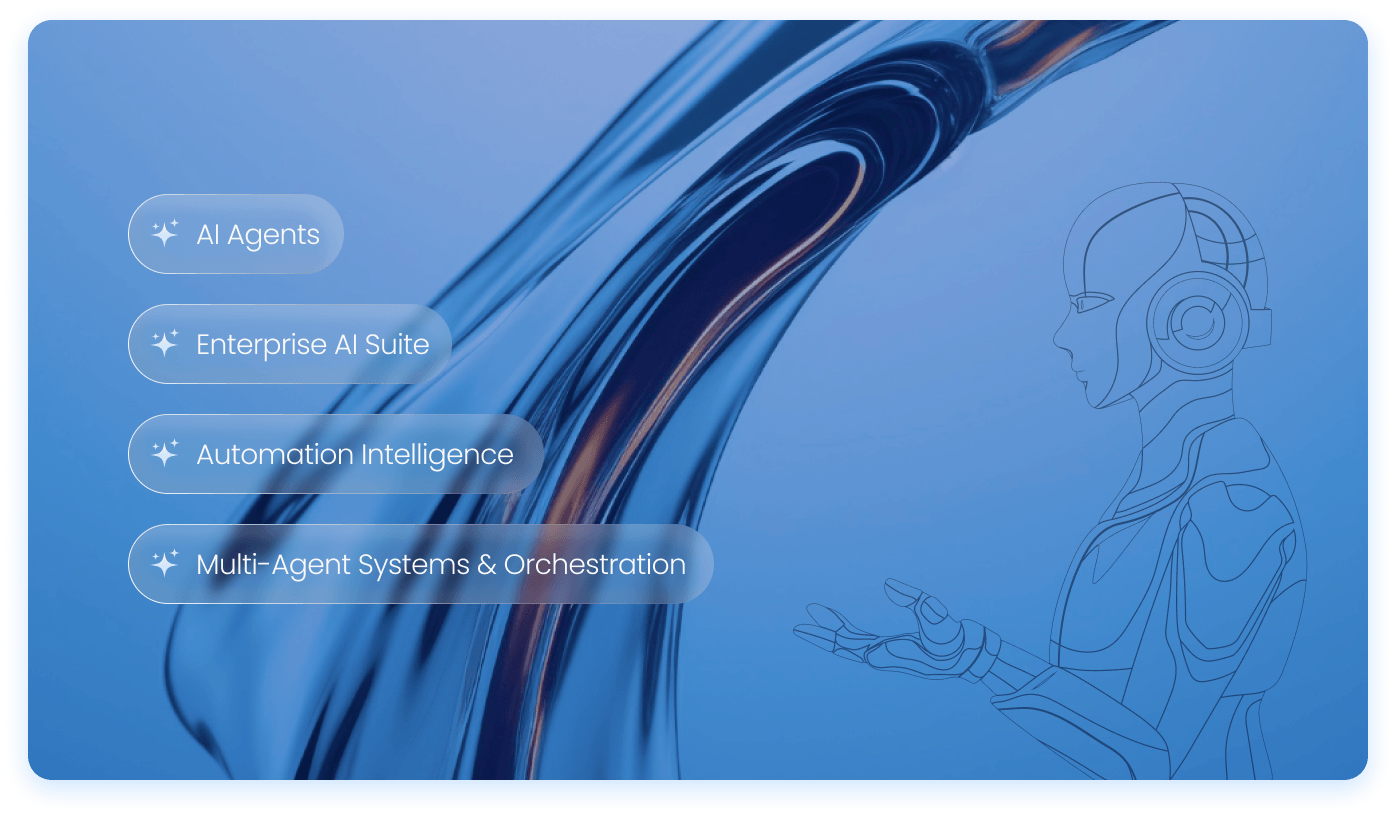
Multi-Agent Systems & Orchestration

When workflows stretch across teams and systems, a single agent is not enough. As your agentic AI development partner, multi-agent systems are designed to collaborate, share context, and execute tasks in parallel, turning fragmented processes into coordinated, intelligent workflows.

What gets architected: Agent role definition, Inter-agent communication, Shared memory and context, Orchestration frameworks

AI Agent Integration

Even the most capable agent fails if it cannot plug into your ecosystem. As your AI agent development company services partner, agents are embedded into your existing stack so they can access data, trigger actions, and operate within real workflows without disruption.

What gets connected: CRM, ERP, Internal databases, Third-party APIs, Communication and workflow tools

AI Voice Agent Development

A large part of business operations still runs on conversations. As your AI voice agent development company, voice agents are built to handle real-time interactions across support, operations, and outreach, reducing dependency on human queues while maintaining context and responsiveness.

What gets deployed: Inbound voice agents, Outbound engagement agents, Support and triage agents, Scheduling and coordination agents

Which AI Agents Should Your Business Be Using?

The impact of AI agents depends on where they are applied. Each type is built to take ownership of a specific class of work, not just assist it.

Task Automation Agents

Repetitive, rule-bound work is one of the biggest drains on operational capacity. Task automation agents handle high-volume workflows end to end, from data entry and document processing to report generation and scheduled operations, without fatigue or error variance.

Best for: Operations, Finance, HR, Legal

AI Voice Agent

Phone queues, intake calls, and follow-ups still consume hours of human time daily. AI voice agents handle these interactions in real time, understanding context, responding naturally, and resolving or routing conversations without delays.

Best for: Healthcare, Customer Service, Sales, Field Operations

Research & Analysis Agents

Decisions made on incomplete or outdated information create hidden costs. Research agents continuously scan sources, synthesize insights, and deliver structured outputs that teams can act on immediately.

Best for: Trading, Legal, Marketing, Strategy Teams

Multi-Agent Systems

Some workflows are too complex for a single agent. Multi-agent systems deploy specialized agents that collaborate, pass context, and execute tasks across workflows without constant human coordination.

Best for: Enterprise Operations, Supply Chain, Financial Services, Healthcare

Autonomous Decision-Making Agents

Time-sensitive decisions cannot wait for manual review. These agents process real-time inputs, apply logic and learned patterns, and execute or escalate with speed and consistency.

Best for: Financial Services, Trading, Retail, Cybersecurity

Agent-Native Software Development

Most software assumes humans are the primary users. Agent-native systems are designed for agents to operate directly, with APIs, workflows, and logic structured for autonomous execution and continuous improvement.

Best for: Tech Companies, SaaS Platforms, Digital-First Enterprises

Ready-to-Deploy Accelerators

Skip long build cycles with pre-configured, use-case-based solutions, designed for faster rollout and measurable impact.

How Are Businesses Using AI Systems Successfully?

Read leading success stories to know how AI systems perform in production environments.

Information Technology(IT)
AUSTRALIA
End-to-End AI Product Development
13%

Hike in user retention rates

2x

Lesser manual testing errors

1000+

Play store downloads

Healthcare & Life Sciences
US
Multi-Agent Systems Deployment in Healthcare
35%

Lower operational load

27%

Faster turnaround

45

Resources redeployed

Don’t just take our word for it…

“The team was highly responsive”
DataToBiz successfully delivered the chatbot, meeting our expectations. The team was highly responsive, they provided prompt support and were quick to adapt to our evolving requirements. Moreover, they impressed us with their technical expertise and project management.

GPI Business services Mumbai, India

“DataToBiz successfully built the AI chatbot ”
DataToBiz successfully built the AI chatbot and gave us access to the admin portal to add new data. The chatbot can have contextual conversations and view or download source documents. Throughout the engagement, the team was responsive and proactive, and they delivered the project on time.

VP Solutions & Digital Innovation, Studio Graphene Information technology Gurgaon, India

“They are passionate people”
DataToBiz is a good choice for someone who wants a partner who understands the product journey, requirements, and delivery expectations. They have the experience and agility to understand what’s possible and deliver to the client’s expectations. They‘re really passionate people, and they know what they’re doing!

GetMee Founder & CEO

What Does an AI Agent Workflow Look Like?

Most enterprises underestimate how many decisions happen between "define the goal" and "agent executes autonomously." This is what that journey actually looks like, and where most implementations get it wrong.

Step 01

AI Readiness Audit

Before anything is built, you need a clear view of where AI agents will actually create impact. The readiness audit identifies which workflows are worth automating, where your current setup may slow things down, and where early ROI can be unlocked without disruption.

What happens: Current stack assessment, Workflow gap analysis, Agent opportunity mapping, Risk identification

Step 02

Strategy & Architecture

Audit insights are translated into a clear, build-ready plan. Agent types, LLMs, orchestration models, and integration paths are defined upfront, so execution does not break on live. 

What happens: Agent type selection, LLM matching, Tech stack definition, Integration planning, Risk mitigation

Step 03

Agent Design & Prototyping

Before full-scale development, core workflows are mapped and validated through prototypes. This ensures the agent logic, decision flows, and interactions are aligned with real use cases, not assumptions.

What happens: Workflow mapping, Agent logic design, Prototype development, Early validation, Feedback alignment

Step 04

Agent Development & Testing

Prototypes evolve into production-ready agents. Built around your data and workflows, each agent is tested across real scenarios to ensure it performs reliably beyond ideal conditions.

What happens: Custom agent build, Prompt engineering, Tool and API integration, Edge case testing, Performance benchmarking

Step 05

Deployment & Integration

Agents are deployed into your live environment and connected to your existing systems. Every interaction point is validated to ensure smooth execution without disrupting ongoing operations.

What happens: Live environment deployment, Stack integration, Handoff and escalation logic, Data flow validation, Go-live sign-off

Step 06

Monitoring, Iteration & Scale

Once live, agents are continuously monitored and refined as workflows evolve. New use cases are added over time, ensuring the system compounds in value instead of plateauing.

What happens: Performance monitoring, Model fine-tuning, Workflow expansion, Capability upgrades, Ongoing support

Why Choose DataToBiz for AI Agent Development?

Your Competitor's AI Agents Are Already Live. Where Are Yours?

Frequently Asked Questions(FAQs)

What types of AI agents does DataToBiz develop for enterprises?

AI agent development companies like DataToBiz develop AI agents for customer support, workflow automation, internal operations, analytics, document processing, enterprise search, and decision support. 

These agents can work across departments like sales, operations, finance, HR, and customer service while integrating with existing business systems and workflows.

Can AI agents integrate with our existing enterprise systems?

Yes. AI agents developed by DataToBiz are designed to integrate with existing enterprise platforms including CRMs, ERPs, cloud environments, communication tools, databases, and internal applications. The objective is to improve operational efficiency without disrupting current infrastructure.

How do you identify the right AI agent use cases for a business?

The process starts with evaluating operational bottlenecks, repetitive workflows, data accessibility gaps, and customer interaction challenges. Based on business priorities and ROI potential, high-impact AI agent use cases are shortlisted for phased implementation.

Discover Your Use Case
Do you build custom AI agents or use prebuilt frameworks?

Both approaches are supported based on project requirements. DataToBiz can develop fully custom AI agents for enterprise-specific workflows or accelerate implementation using proven frameworks, APIs, and LLM ecosystems to reduce development timelines.

How secure are enterprise AI agent solutions at DataToBiz?

Security is addressed via controlled data access, role-based permissions, secure APIs, encrypted communication, and governance-focused deployment practices. AI agent architectures are aligned with enterprise compliance and security requirements across industries and regions.

How long does it take to develop and deploy an AI agent?

Project timelines depend on complexity, integrations, and workflow requirements. Simple AI assistants may take a few weeks, while enterprise-grade multi-agent systems with integrations and governance layers may require phased deployment across several months.

Can AI agents work with private enterprise data?

Yes. AI agents can securely interact with enterprise knowledge bases, internal documents, operational systems, and structured databases. Access controls and governance policies are implemented to ensure sensitive business information remains protected.

What industries can benefit from AI agent development services?

AI agents are being adopted across industries, including healthcare, manufacturing, logistics, retail, finance, energy, SaaS, and professional services. Common applications include customer engagement, workflow automation, knowledge retrieval, reporting assistance, and operational monitoring.

  Get an AI ROI Consultation
How do you measure the success of AI agent implementation?

Success is measured through KPIs such as response time reduction, process automation rates, operational efficiency gains, employee productivity, customer satisfaction, and cost optimization. Performance tracking continues post-deployment to identify optimization opportunities.

Do you provide post-deployment support for AI agents?

Yes. Post-deployment support includes monitoring, prompt optimization, workflow refinement, performance tuning, integration support, and onboarding of additional use cases as business requirements evolve.

What technologies and LLMs do you work with for AI agent development?

DataToBiz works with leading AI ecosystems, cloud platforms, vector databases, orchestration frameworks, and large language models, including OpenAI, Anthropic, Azure OpenAI, Gemini, and open-source LLMs based on enterprise requirements and deployment preferences.

How do you ensure AI agents remain scalable as business needs grow?

AI agent architectures are designed with modular components, scalable APIs, cloud-native infrastructure, and workflow extensibility. This allows enterprises to add new use cases, users, integrations, and data sources without rebuilding the entire solution.

What engagement models do you offer for AI agent development projects?

Engagement models include fixed-scope projects, dedicated development teams, AI consulting, managed support, and staff augmentation. Enterprises can choose a model based on project timelines, internal capabilities, and long-term AI adoption goals.

Can enterprises hire dedicated AI agent developers from DataToBiz?

Yes. Alongside end-to-end project delivery, DataToBiz also provides AI developers, ML engineers, data engineers, and solution architects through flexible staff augmentation models for short-term or long-term enterprise requirements.

  Hire AI Developers
DMCA.com Protection Status