
 5 Stars Rated On Clutch

Energy, Utilities & Resources
Africa
Staff/Resource Augmentation
To scale predictive maintenance across their Azure ecosystem, we deployed two Senior Data Scientists to design, build, and operationalize AI models within the client’s existing infrastructure, without disrupting ongoing operations.
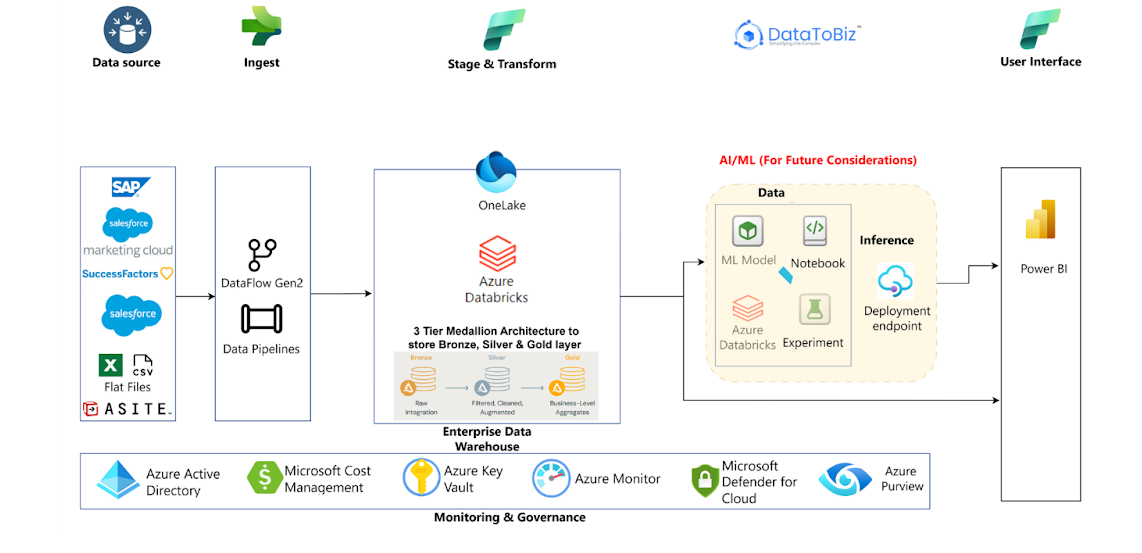
We used Azure Data Factory and Azure Event Hub to ingest high-volume IoT sensor data and maintenance logs into a centralized Azure Data Lake, built on a scalable, modular architecture to handle growing data loads.
Databricks with PySpark enabled distributed data preprocessing at scale. Models for anomaly detection and equipment failure prediction were developed and trained using Azure Machine Learning.
Models were deployed using Azure Synapse, Azure Functions, and Logic Apps to enable real-time inference.
Performance metrics, data drift, and anomaly patterns were tracked continuously through Azure Monitor, with automated alerts triggering retraining or escalation when needed.
To ensure long-term sustainability, we conducted hands-on training, shared detailed documentation, and hosted internal workshops.
All pipelines were built to meet POPIA compliance, with strict encryption protocols, role-based access control (RBAC), and secure data policies in place. Automated retraining workflows were implemented to keep models responsive and relevant over time.
To address the client’s need for a unified, automated ML lifecycle, our team of data engineers built a scalable MLOps platform on Azure.
Databricks with PySpark was used for data preprocessing and model training.
Model development, tuning, and deployment were automated using Azure Machine Learning.
Models were containerized and deployed on Azure Kubernetes Service (AKS) for scalable inference.
Azure Monitor and Application Insights tracked model performance and detected drift.
Automated alerts and retraining workflows helped maintain reliability and model freshness.
Supervised learning models powered failure prediction and anomaly detection.
Time-series analysis was used to improve accuracy in maintenance scheduling.
Power BI dashboards presented real-time asset health and key performance metrics.
Role-based access control (RBAC) ensured secure and structured data access.
Early fault detection models helped catch issues before they escalated, cutting unexpected failures by 50% and keeping operations running smoothly.
Automated alerts and insights optimized maintenance scheduling, improving efficiency by 35% and minimizing unnecessary servicing.
Real-time monitoring and alerts enabled field teams to respond 60% faster to potential issues, reducing average resolution time significantly.
By shifting to a proactive maintenance strategy, the client saw a 45% increase in asset life, reducing replacement costs and downtime.
Power BI dashboards provided live visibility into asset health, uptime, and fault trends, allowing operations teams to act on anomalies as they happened.
With skilled staff augmentation, the team was able to hit critical milestones faster and complete knowledge transfer without delays, boosting internal productivity.
All-in-all, our team of staffing experts helped the client take predictive maintenance from pilots to full-scale operations. With automated deployment, monitoring, and retraining in place, the client reduced downtime, improved asset reliability, and gave their teams the talent and tools to make faster, smarter maintenance decisions.
Submit your details & our experts will reply you with a quote very soon.
Your information is kept secure and confidential. We respect your privacy and will not share your data with third parties without your consent.

DataToBiz is a good choice for someone who wants a partner who understands the product journey, requirements, and delivery expectations. They have the experience and agility to understand what’s possible and deliver to the client’s expectations. They‘re really passionate people, and they know what they’re doing!
We’re impressed with DataToBiz’s professionalism, dedicated support, and consistent follow-ups. Their team maintains clear communication through online meetings, ensuring a smooth and reliable collaboration.
A solution like this is a good fit if your teams spend more time collecting and reconciling data than acting on it, if reports from different departments do not match, or if decisions depend on delayed or manual reporting. It also fits when your data is growing in volume or sources, and your current setup struggles to keep up.
DataToBiz starts with a discovery call to review your goals, data sources, and reporting gaps. You get a clear view of the expected outcomes, effort, and timeline before any commitment.
Yes. Every solution DataToBiz delivers is configured around your industry, business processes, and existing data environment. The team assesses your current systems, data quality, and reporting needs first, then designs a solution that works with what you already have instead of replacing it. This applies across industries such as manufacturing, retail, healthcare, finance, and logistics, and across setups ranging from legacy databases to cloud data platforms.
DataToBiz works across the major analytics, cloud, and data engineering stacks. For BI and visualization, this includes Power BI, Tableau, and Looker. For cloud platforms, it includes Microsoft Azure, AWS, and Google Cloud. For data warehousing and processing, it includes Snowflake, Databricks, and SQL-based databases. Data sources include ERP and CRM systems, spreadsheets, APIs, IoT and sensor data, and third-party applications.
If your stack includes a tool not listed here, the team can assess compatibility during discovery.
Most projects with DataToBiz take from a few weeks to a few months. The timeline depends on how ready your data infrastructure is for the initiative and how many systems need to connect. Smaller solutions go live quickly, while larger programs roll out in phases so you see value early. After an initial discovery call, you receive a timeline with clear milestones.
Security and governance is part of the plan from the first conversation. DataToBiz works within your security policies and follows the regulations that apply to your industry. The project usually Access stays limited to the people who need it, and confidentiality terms cover the engagement from kickoff to handover.
The work does not stop at go-live. Your team gets a proper handover and guidance on using the solution, and DataToBiz stays available for questions and improvements. The business impact of the project is measured against the goals set at the start, so you can see exactly what changed for your company.

DataToBiz is a Data Science, AI, and BI Consulting Firm that helps Startups, SMBs and Enterprises achieve their future vision of sustainable growth.
DataToBiz is a Data Science, AI, and BI Consulting Firm that helps Startups, SMBs and Enterprises achieve their future vision of sustainable growth.